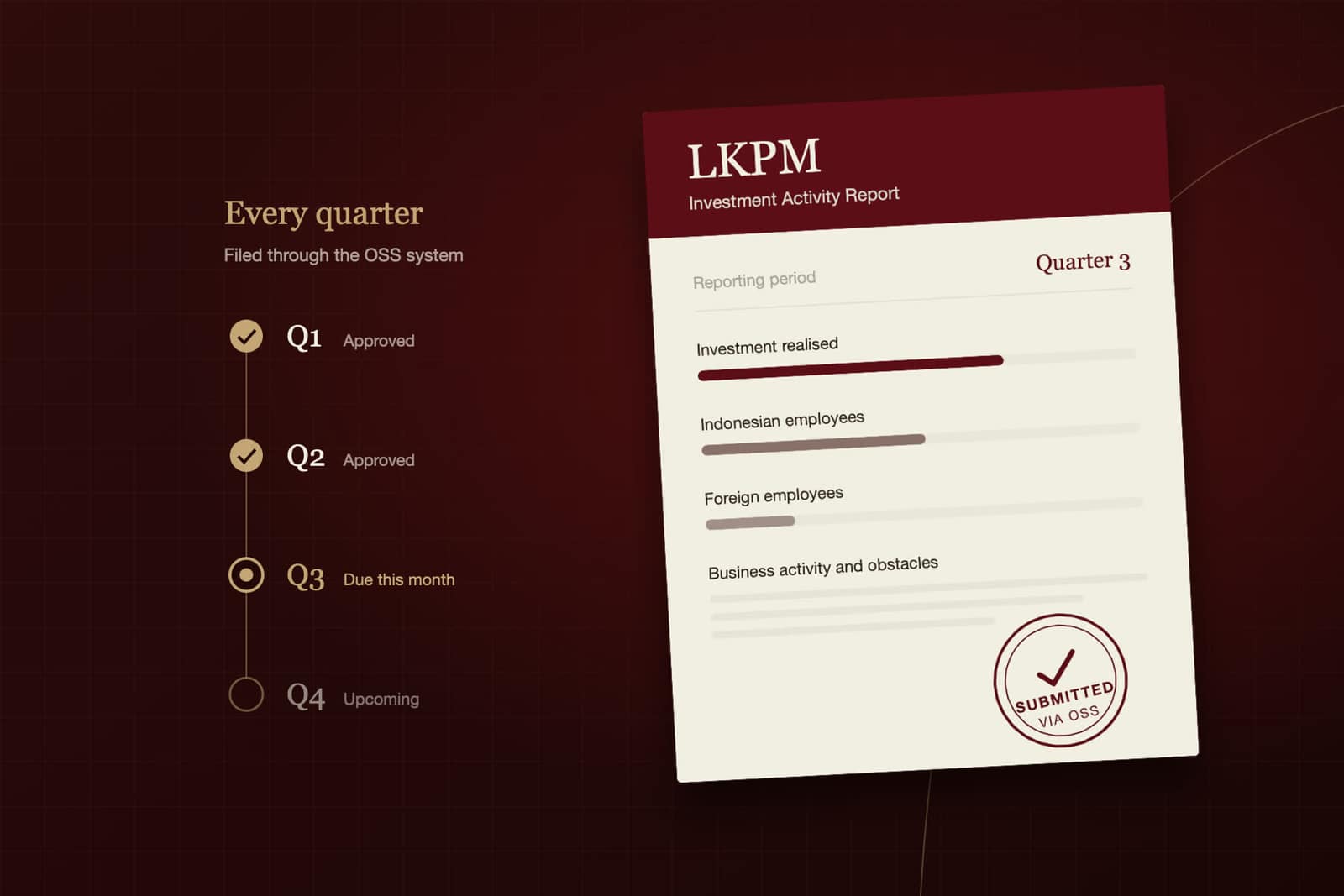
LKPM (Laporan Kegiatan Penanaman Modal) is the investment activity report that companies with an investment licence submit to Indonesia's investment authority through the OSS system. For a PT PMA it is one of the first recurring obligations, and one of the easiest to miss.
Who files, and how often
- Medium and large businesses, which includes every PT PMA, file every quarter.
- Small businesses file every six months. Micro businesses are exempt.
- A report is filed for each business activity and location, from the moment the company has its NIB.
- Reports are expected even in quarters with no activity. A company that is not yet operating files a preparation-stage report.
What the report covers
- Investment realised in the period, such as capital spent on equipment, buildings or working capital
- The number of Indonesian and foreign employees
- Production of goods or services, where relevant
- Fulfilment of licence requirements and investor obligations, such as training, partnership, environmental management and employment
- Problems or obstacles the company has faced
The figures should be consistent with your financial records and with what the company declared when it registered.
When it is due
Under Article 286 of BKPM Regulation No. 5 of 2025, quarterly reports are due by the 15th of the month after each quarter ends:
| Quarter |
Due by |
| Q1 (January–March) |
15 April |
| Q2 (April–June) |
15 July |
| Q3 (July–September) |
15 October |
| Q4 (October–December) |
15 January of the following year |
Small businesses file by 15 July for the first half and by 15 January for the second. If a deadline falls on a public holiday, OSS announces the adjusted date. OSS issues a receipt for each report, so keep it with your records.
Why you see different dates online
Older guides give the 10th of the month. Under BKPM Regulation No. 5 of 2025 the deadline is the 15th (Article 286), and the 2021 BKPM regulations it replaced were revoked (Article 398).
What happens if you miss it
Under Articles 373 to 376 of the same regulation, sanctions start when a company misses two reporting periods in a row, or reports no new investment for four periods in a row. The steps are:
- A first, second and third written warning, one for each further period missed
- Temporary suspension of business activities, together with an administrative fine
- Revocation of the business licence if the report is still not filed and the fine is not paid
Each warning lapses once the missing report is filed, so catching up quickly matters.
A quarterly checklist
- Confirm the reporting period and the deadline shown in OSS.
- Collect investment spending for the quarter from your accounts.
- Update employee numbers, Indonesian and foreign.
- Note any change in business activity or location.
- Submit through OSS and save a copy.
- Check that the status changes to approved.
Keeping it on schedule
LKPM is simple when it is part of a routine and stressful when it is remembered at the last minute. Many companies bundle it with bookkeeping and tax reporting so the same figures feed all three. See our Tax & Compliance services and the Annual Compliance package.
This note is general information, not legal or tax advice. Regulations in Indonesia change often, so confirm the current requirements for your situation before acting. How we research and review our guides.